Inside the Black Box
A beginner’s attempt to make sense of AI, and the surprising places it led.
In June 2026 I spent four days at the AI Boot Camp hosted by Duke-NUS Medical School and the Tianqiao and Chrissy Chen Institute, alongside other researchers.
Before the course, I knew how to use AI tools, but that was about the extent of it. My questions were the ones you ask when you’ve never looked under the hood. Why does a model give me a different answer each time I ask the same thing? What actually happens between typing a prompt and getting a reply?
By the end of the week, I had answers to both, and a much clearer mental model of how these systems actually work. A large language model is only one part of the pipeline, and much of what shapes a response is determined by the information, context and tools around it.
What has stayed with me most, though, is how often something I already knew from neuroscience turned up in AI with a name, a formal definition, and a body of research behind it.
Both questions have the same answer
The answer to my first question was surprisingly simple. A language model doesn’t retrieve a stored answer; it generates one from scratch, one token at a time. Because there’s a little randomness in how each next token is chosen, the same prompt won’t always produce the same response.
The second question turned out to be much more interesting. I’d always imagined the model was the system. In reality, it’s just one stage in a much larger pipeline. Before it runs, information may be retrieved, instructions assembled and context prepared. Afterwards, its output can be checked, sent to external tools, or even fed back into another round of reasoning. Once I saw where retrieval, agents and the rest actually fit, they stopped feeling like disconnected buzzwords and started making sense as different ways of building around the same underlying model.
More importantly, it changed how I think about using AI. Instead of endlessly rewording prompts, I now find myself asking whether the model has the information it needs in the first place, or whether the task really calls for something beyond the model alone.
The unexpected connection
Knowledge graphs were one of many topics we covered, but they were the one that stayed with me. While a language model learns patterns from vast amounts of text, a knowledge graph stores information explicitly as entities and the relationships between them. That makes it possible to organise information from different sources, keep it up to date, and answer questions by following those relationships instead of relying solely on what a model happened to learn during training. Modern AI systems increasingly combine both, using knowledge graphs to provide structured, reliable information and language models to interpret it and communicate it naturally.
The more we talked about knowledge graphs, the more familiar they started to feel.
I realised that neuroscience already describes much of the brain in exactly those terms. A neuron forms synapses onto another neuron. It releases a neurotransmitter. That neurotransmitter binds to a receptor on the postsynaptic cell. Neurons have cell bodies in one region and project to others. We rarely think of this as a knowledge graph, but it has exactly the same structure: well-defined entities connected by well-defined relationships.
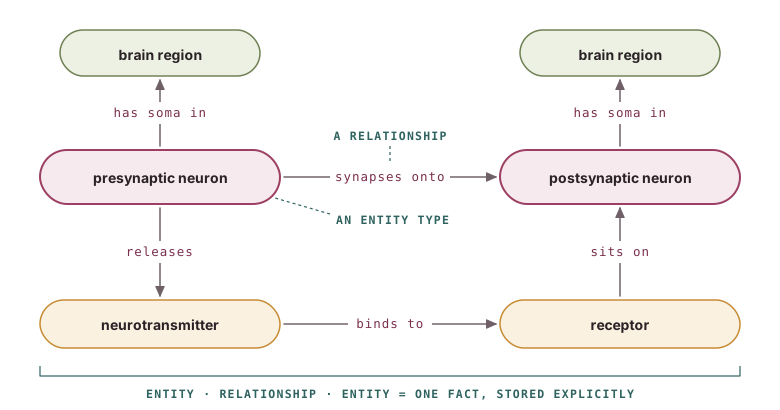
Figure 1. Synaptic neuroscience as a knowledge graph. Boxes are entity types, arrows are named relationships, and teal labels show the corresponding AI concepts. Brain region appears on both sides because each neuron has its soma in one.
In AI, that generic structure is called a schema: it defines the kinds of entities that exist and the relationships they’re allowed to have. Biology builds the same thing and tends to call them ontologies, like the Gene Ontology or the anatomy ontologies used in fly work, though the term is used well beyond biology. Populate that structure with real neurons, neurotransmitters and brain regions, and you have the data.
One example comes from my own work. I study the fruit fly Drosophila, and Figure 2 shows a small part of the mushroom body, where flies learn to associate odours with reward and punishment. Kenyon cells carry the odour information, output neurons (MBONs) read it out, and each compartment has its own dopaminergic neuron.
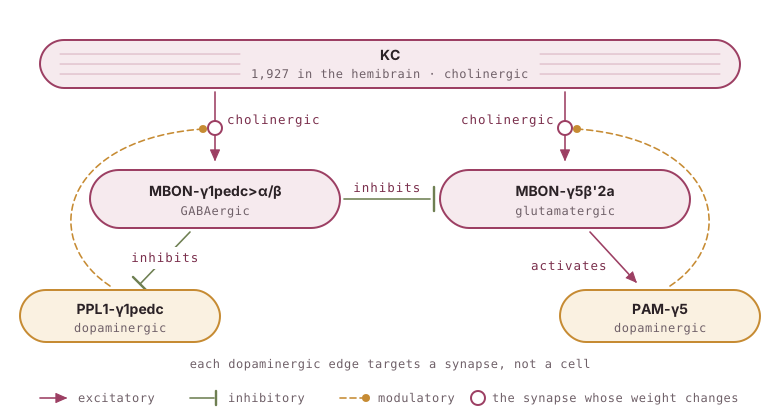
Figure 2. Two compartments of the mushroom body. The same Kenyon cell axons run through both, so both output neurons read the identical odour code. Each compartment has its own dopaminergic neuron, and neither touches the output neuron: they act on the Kenyon cell synapse, which is why those arrows terminate on the open circles. Both circled synapses are plastic. Circuit adapted from Li et al. (2020).
The same cholinergic Kenyon cell axons pass through both compartments, so both output neurons are reading the same odour information. In one compartment, that input drives MBON-γ1pedc>α/β, which is GABAergic. In the other, it drives MBON-γ5β’2a, which is glutamatergic. Each compartment has its own dopaminergic neuron, but neither acts directly on the output neuron. Instead, they modify the Kenyon cell synapse itself, which is why the arrows point to the circled synapses rather than the neuron boxes. Those synapses are the only part of the circuit that changes during learning.
The two compartments then feed back onto one another. MBON-γ1pedc>α/β inhibits MBON-γ5β’2a while also suppressing its own dopaminergic input. MBON-γ5β’2a pushes in the opposite direction, exciting its own.
Every noun in that description is an entity. Every arrow is a typed, directed relationship. That’s exactly how a knowledge graph represents information (the hemibrain connectome is stored in a graph database called Neo4j: neuprint.janelia.org).
Looking back, the biggest takeaway wasn’t learning what a knowledge graph is. It was realising I’d been using one all along.
Confident isn’t the same as correct
One discussion that stuck with me was around trust. The challenge isn’t getting an AI system to produce an answer. It’s knowing when that answer deserves to be believed.
What surprised me was how little a generated response tells you about its own reliability. A convincing answer and a correct answer can look exactly the same. You don’t get uncertainty for free.
That immediately reminded me of science. We spend so much time worrying about controls, replication, sample sizes and provenance because we’ve learnt that a polished result can still be wrong. A result doesn’t become true by looking convincing.
The difference is that scientific work leaves a trail. You can read the methods, inspect the data, and ask where a conclusion came from. With AI, that trail often has to be built deliberately, whether through retrieval, citations or other forms of grounding.
What makes learning stick
Whether the example was clinical decision-making or financial markets, the underlying loop looked remarkably similar. You start with an expectation, compare it with what actually happened, and use the difference to update what you’ll expect next time. That difference, the prediction error, is what drives learning. If the outcome was exactly what you expected, there’s little left to update.
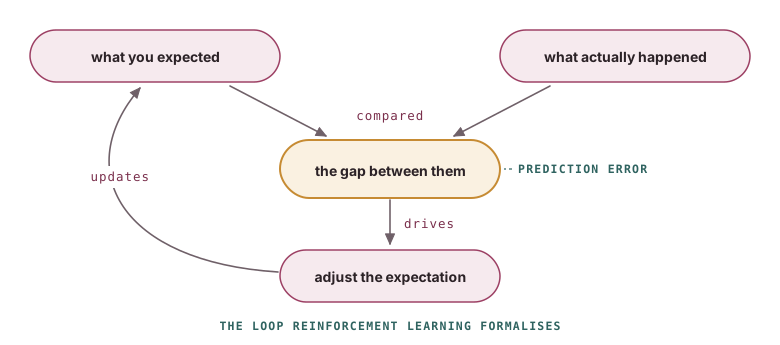
Figure 3. A minimal prediction-error loop. An expected outcome is compared with the observed outcome, and the difference between them is used to update future expectations.
Once I started thinking about it that way, it seemed obvious. We don’t usually change our behaviour because something happened. We change it because something happened that we didn’t expect.
You leave home expecting the bus at ten past. It doesn’t arrive until twenty past, so the next morning you head out a little earlier. If it arrives exactly when you expected, there’s almost nothing to update. Learning comes from the mismatch between expectation and reality, not from the event itself. The learning wasn’t caused by the event. It was caused by the gap between your expectation and reality.
Final thoughts
Four days isn’t enough to understand AI, and I certainly didn’t leave feeling like I did. What changed was that the field stopped feeling like a black box. I can now picture how the pieces fit together, and that’s made it much easier to understand what I’m reading, what I’m asking, and what I still need to learn.
I don’t think neuroscience is “becoming AI”, or that AI somehow invented these ideas. If anything, the two fields have often been asking similar questions from different directions. The boot camp didn’t change what I do in the lab. It changed the language I have for thinking about it.
This was a fundamentals course, so there was never any chance of covering everything. I came away with far more questions than I started with, but this time they felt like questions I could actually begin answering.
My thanks to the speakers, the organising committee, and the student volunteers for four dense, thoughtful and genuinely educational days.
References
Aso, Y. et al. (2014). The neuronal architecture of the mushroom body provides a logic for associative learning. eLife 3:e04577.
Barnstedt, O. et al. (2016). Memory-relevant mushroom body output synapses are cholinergic. Neuron 89:1237-1247.
Clements, J. et al. (2022). neuPrint: An open access tool for EM connectomics. Frontiers in Neuroinformatics 16:896292.
Costa, M. et al. (2013). The Drosophila anatomy ontology. Journal of Biomedical Semantics 4:32.
Felsenberg, J. et al. (2018). Integration of parallel opposing memories underlies memory extinction. Cell 175:709-722.
Hige, T. et al. (2015). Heterosynaptic plasticity underlies aversive olfactory learning in Drosophila. Neuron 88:985-998.
Li, F. et al. (2020). The connectome of the adult Drosophila mushroom body provides insights into function. eLife 9:e62576.
Owald, D. et al. (2015). Activity of defined mushroom body output neurons underlies learned olfactory behaviour. Neuron 86:417-427.
Pavlowsky, A. et al. (2018). A GABAergic feedback shapes dopaminergic input on the Drosophila mushroom body to promote appetitive long-term memory. Current Biology 28:1783-1793.
Scheffer, L.K. et al. (2020). A connectome and analysis of the adult Drosophila central brain. eLife 9:e57443.