What My Focus Logs Say
The last weeks before my thesis defense, as logged by my own focus timer, and what they showed me about how I actually worked.
While writing my PhD thesis, I built Focus Pocus, a small desktop timer that nudged me when I drifted off. For every session, it logged when it ended, how long I focused, how long I paused, how often it caught me wandering, and how productive I felt, rated by me at the end. I spent my PhD observing and measuring flies, and for these weeks, the animal in the experiment was me.
This post is my take on the Focus Pocus tool and the data it collected. The app was fully working only by early February, so the logs ran from then until the day before my defense in March, which was 26 days of records.
282 hours
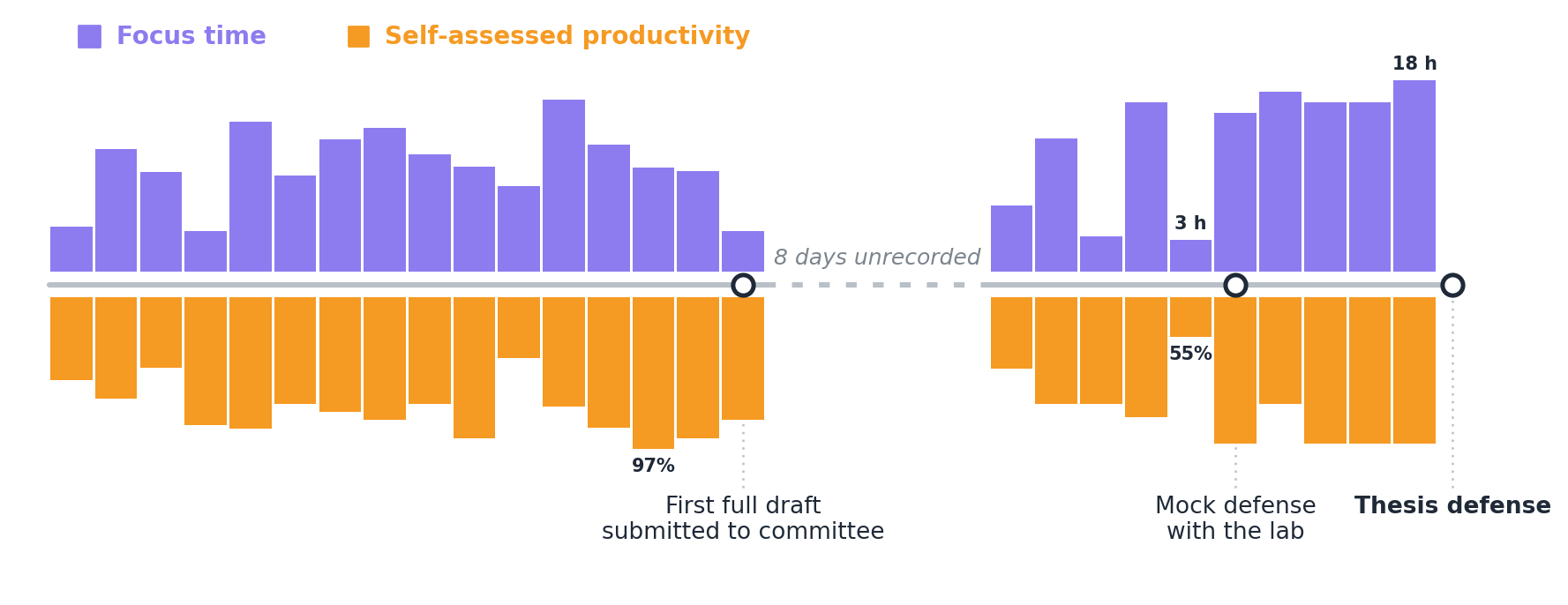
Figure 1. Total focus time per day (purple, above the line) and my self-assessed productivity (orange, below the line). Points on the line mark the milestones: the first full draft submitted to the committee, the mock defense with the lab and the thesis defense.
Those 26 days added up to 282 hours of focus, about 11 focus hours a day. This was not how long it took to write my thesis per day. In reality, I would only use Focus Pocus when I needed the discipline, for long and unbroken stretches of writing where drifting off would have cost me. Days when I didn’t need that help, or was in the lab doing experiments, went unlogged. So the 282 hours were the hardest hours for me during my thesis writing.
Burning the midnight oil
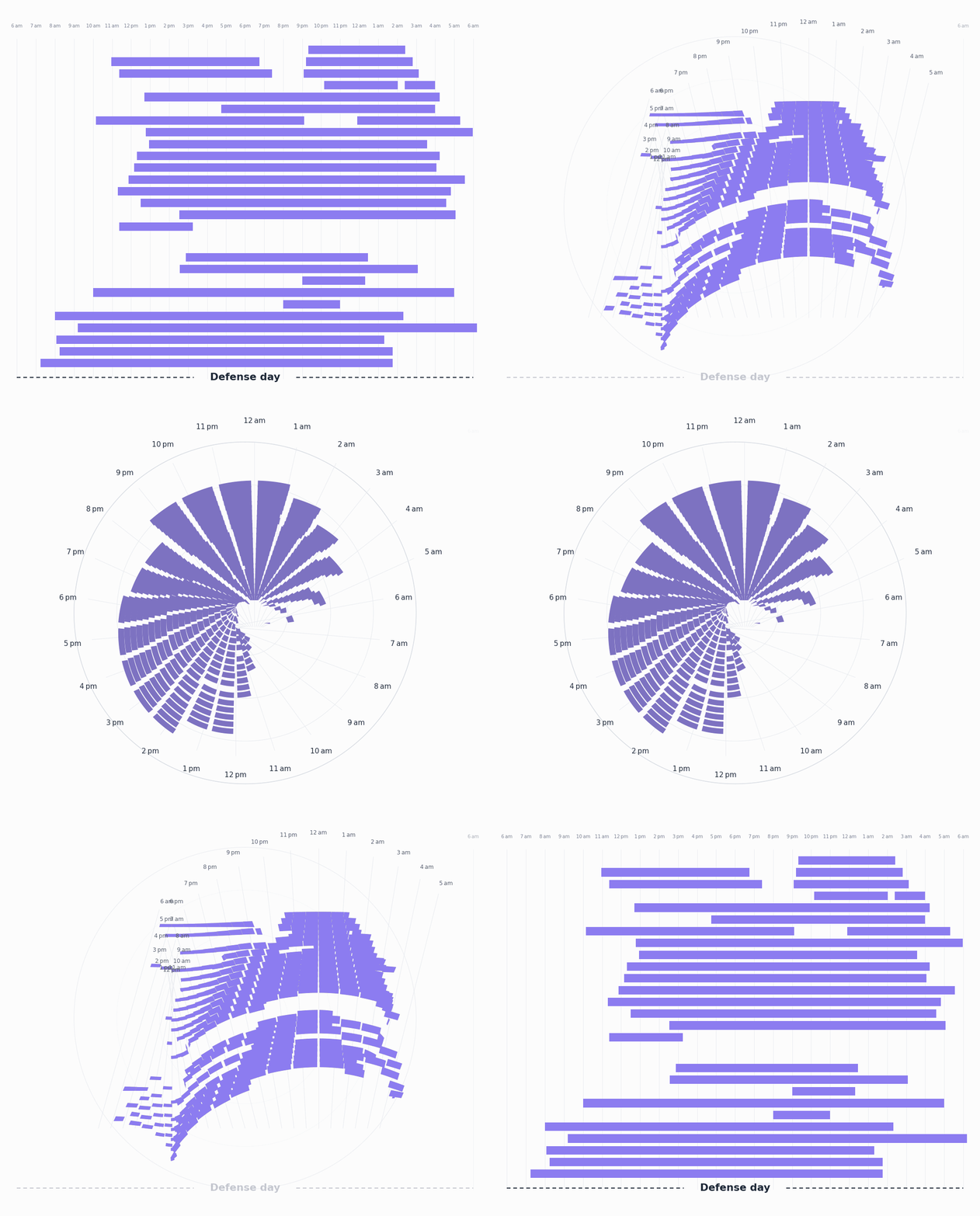
Figure 2. When in the day I was working. Each row is one recorded day, with its sessions drawn from 6am to 6am. The sessions then break apart at each hour and stack into a 24-hour clock, where the length of each bar shows the share of recorded days on which I worked during that hour. The outer circle is 100% of days.
The clock shows how late my days ran. I was often working past midnight on 24 of the 26 days, and on 16 of them I didn’t stop until somewhere between 3 and about 6am. That wasn’t because I’m a night owl. The work simply needed the hours, so even on days I woke up early, I still went to bed late.
One point to note when reading this clock: As mentioned before, Focus Pocus only records when I pressed start, not when my day began.
Nudges, breaks and productivity
The app’s whole premise was that catching yourself drifting helps. So, did nudged days feel less productive, did breaks track the length of the day, and did long days feel better or worse?
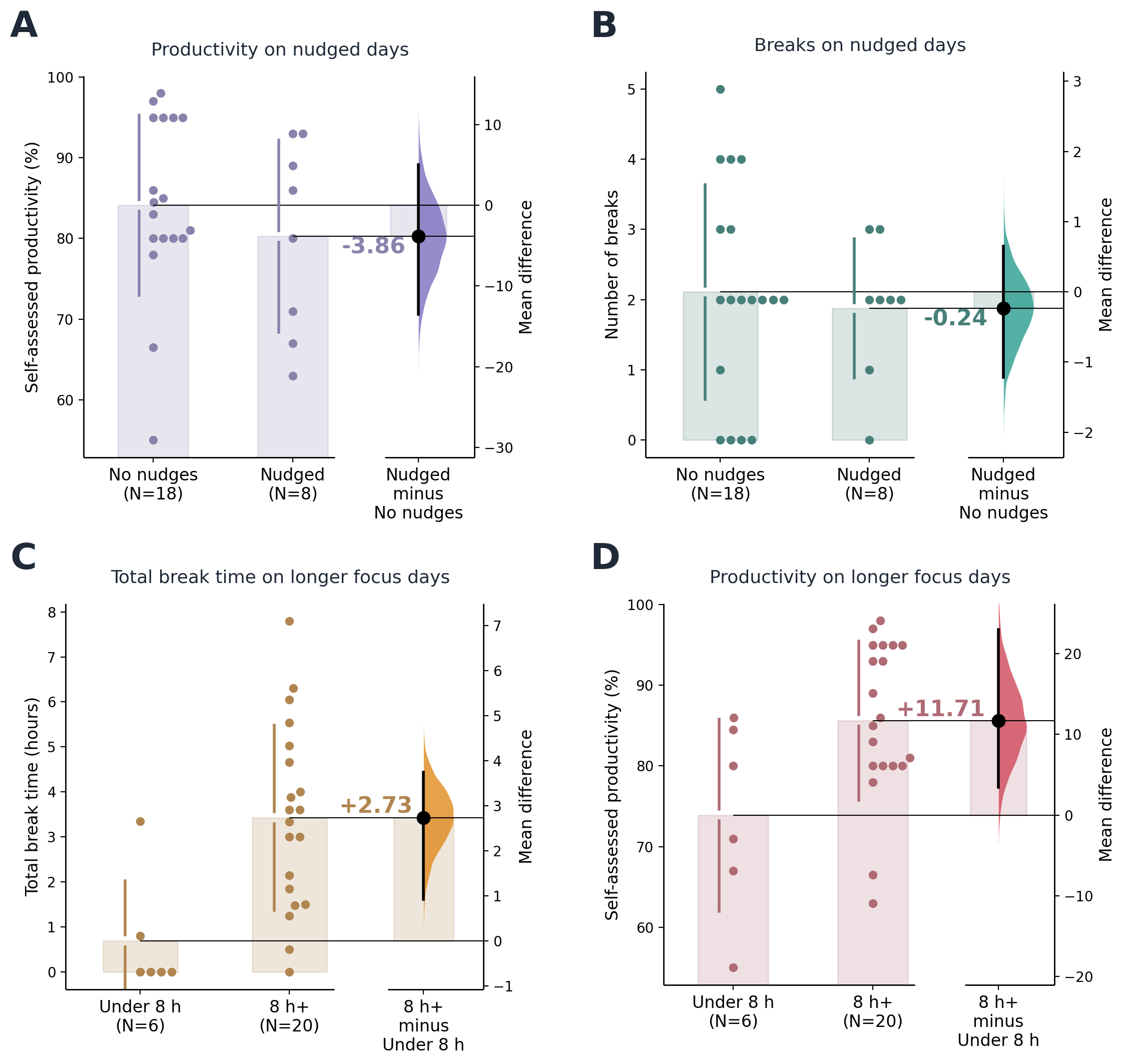
Figure 3. Nudges, breaks and self-assessed productivity across the 26 recorded days. All four panels are estimation plots made with DABEST. Left: each dot is one day, and the height of the bars shows the group mean. Gapped lines show the mean ± SD. Right: the mean difference (Δ) between the two groups, with its 95% CI. (A) Self-assessed productivity on days with no nudges (n = 18) versus days with at least one nudge (n = 8). (B) Number of breaks on the same days. (C) Total break time on days with under 8 hours (n = 6) versus 8 or more hours of focus (n = 20). (D) Self-assessed productivity on the same days as C.
Nudged days felt only slightly less productive, a small drop of about 4% compared with days without nudges (Δ = −3.86; Hedges’ g = −0.33, Cliff’s δ = −0.20; Fig. 3A). Nudges also barely changed the number of breaks I took (Δ = −0.24; Hedges’ g = −0.16, Cliff’s δ = −0.08; Fig. 3B).
A normal working day in Singapore is 8 hours1, so I used that to split my days into normal (< 8 h) and long (≥ 8 h) ones. On long days, I took more breaks and had longer breaks in total (Δ = +2.73; Hedges’ g = 1.37, Cliff’s δ = 0.77; Fig. 3C). Longer days also felt clearly more productive than normal ones to me (Δ = +11.71; Hedges’ g = 1.10, Cliff’s δ = 0.52; Fig. 3D).
So, as expected, the longer I worked, the more breaks I took, yet the more productive I felt. However, all of this came at a cost.
The cost of those hours
Focus Pocus counted hours, not what they cost. A thesis asks for a particular kind of thinking: holding years of experiments in your head at once and turning them into one argument, day after day, with no real break from it. By the final weeks, I could feel my health deteriorating. My stamina dropped drastically, since I had stopped exercising entirely and could barely walk 1000 steps without panting. I started experiencing memory lapses and had dramatic hair loss. I can still vividly remember the morning when my whole body felt so tired and heavy that I physically struggled walking to the desk. These were all experiences that would never be recorded in the data or in my thesis, but they will live forever in my memory.
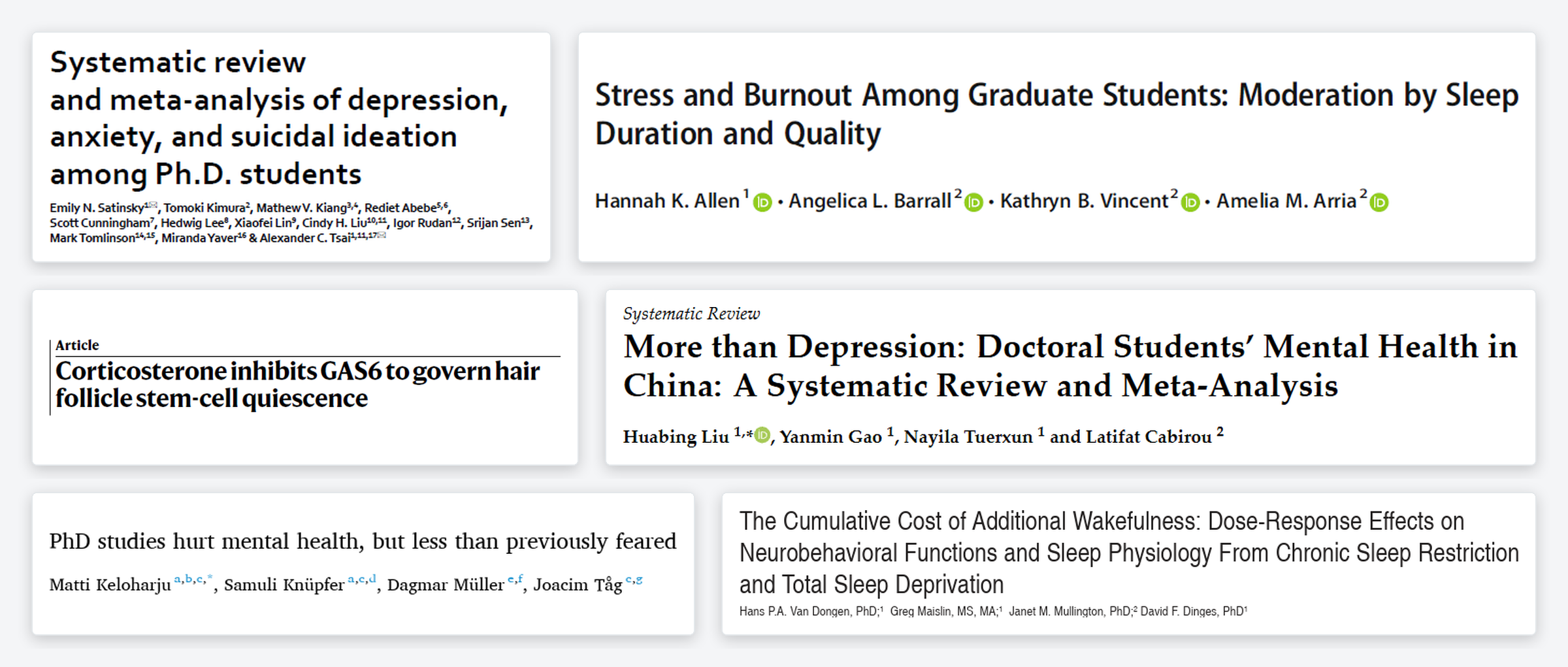
Figure 4. A few of the papers behind this section, on PhD students’ mental health and on what stress and lost sleep do to the body and mind. Full references are listed below.
However, I was not the only doctoral student facing these challenges. In a survey of 3,659 PhD students in Flanders, Belgium, 32% were at risk of a common psychiatric disorder, most often depression2. A meta-analysis found clinically significant depressive symptoms in about 24% of PhD students3. Swedish health records give a lower number, about 7% receiving medication or a diagnosis for depression in a given year, but still show that doctoral study takes a toll4. In Australia, impostor thoughts, perfectionism and loneliness were strong predictors of depression and anxiety in PhD students5. Closer to home, a review of 35 Chinese-language studies found doctoral students in China above population norms on several symptom scales, most consistently interpersonal sensitivity, then depression and somatization6. Even hair loss may have a mechanism: in mice, the stress hormone corticosterone keeps hair follicle stem cells resting, so new hair stops growing7.
The biggest blind spot was sleep. I was barely sleeping through most of these weeks (~4h to 6h at best), logged or not. In a classic lab study, six hours a night for two weeks left people as impaired as a full night without sleep on key attention and memory tests, and they were largely unaware of it8. Among 2,683 graduate students, stress was less strongly linked to exhaustion in those who slept longer and better9. And when 28 interior design undergraduates at Baylor University in Texas wore sleep-tracking wristbands for a week, those whose sleep was short or varied a lot from night to night did worse on attention and creativity tests. The researchers concluded that a regular sleep schedule matters at least as much as total sleep10.
So the hours in Figure 1 came with a cost the logs never saw, and judging by the research, I was far from alone in paying it.
What I’d take from it
Focus Pocus was good at what it was intended to do: keeping me on track whenever I needed help. Longer days did tend to have better productivity, but numbers never told the whole story.
That productivity was also my own rating at the end of each session, so it’s subjective. Whether I was really productive, the data can’t tell me. Some days I wrote ten pages of my thesis, and other days, I only finished a single figure. On paper, the figure looked like less work, but it could take round after round of analysis and redesign before it told the right story. Those days weren’t efficient, and some work can’t be, but they still felt productive to me.
In the future, if I choose to continue developing the app, I would log more diligently and record when each break happened, not just how long it lasted. The timer could also start on its own whenever I opened my thesis files, so the logs no longer depended on me remembering to press start. Next would be linking the logs to my watch’s health data: sleep, heart rate, HRV and stress. I left that out only because my old watch was too bulky to wear while typing. All that typing had also given me wrist tendonitis, so I chose not to strain my wrist further.
From the time I halted major experiments to write my thesis until my defense day, I gave up exercise and proper sleep, and lived with stress far above normal. The defense went splendidly well (I graduated!), but this lifestyle is not a recommendation. I still believe good sleep and enough rest are what let you work and function properly, and it’s what I’d tell anyone doing a PhD now or about to start one.
Thank you to my supervisor, Prof Adam Claridge-Chang, and to my TAC, the PhD admin team and my lab mates, who made the lab feel like a second home. To my parents and my grandma: your dedication and endless warmth shaped who I am, and this thesis is as much a result of your love as of my work. I’ll carry it with me through every chapter yet to come. And to my partner and close friends: thank you for the constant encouragement, the food when I forgot to eat, and for believing I could do this, even at 3am.
References
- Ministry of Manpower, Singapore. Hours of work, overtime and rest days (accessed November 2026). mom.gov.sg
- Levecque, K. et al. (2017). Work organization and mental health problems in PhD students. Research Policy 46:868-879. doi:10.1016/j.respol.2017.02.008
- Satinsky, E.N. et al. (2021). Systematic review and meta-analysis of depression, anxiety, and suicidal ideation among Ph.D. students. Scientific Reports 11:14370. doi:10.1038/s41598-021-93687-7
- Keloharju, M. et al. (2024). PhD studies hurt mental health, but less than previously feared. Research Policy 53:105078. doi:10.1016/j.respol.2024.105078
- Mills, L. et al. (2024). A study into the mental health of PhD students in Australia: investigating the determinants of depression, anxiety, and suicidality. Scientific Reports 14:22636. doi:10.1038/s41598-024-72661-z
- Liu, H. et al. (2026). More than depression: doctoral students’ mental health in China: a systematic review and meta-analysis. Behavioral Sciences 16:1355. doi:10.3390/bs16081355
- Choi, S. et al. (2021). Corticosterone inhibits GAS6 to govern hair follicle stem-cell quiescence. Nature 592:428-432. doi:10.1038/s41586-021-03417-2
- Van Dongen, H.P.A. et al. (2003). The cumulative cost of additional wakefulness: dose-response effects on neurobehavioral functions and sleep physiology from chronic sleep restriction and total sleep deprivation. Sleep 26:117-126. doi:10.1093/sleep/26.2.117
- Allen, H.K. et al. (2021). Stress and burnout among graduate students: moderation by sleep duration and quality. International Journal of Behavioral Medicine 28:21-28. doi:10.1007/s12529-020-09867-8
- King, E. et al. (2017). Sleep in studio based courses: outcomes for creativity task performance. Journal of Interior Design 42:5-28. doi:10.1111/joid.12104